
You may be able to finance an engagement ring through jeweler financing, a personal loan, a credit card, or a buy now, pay later plan. The right option depends on your budget, credit history, and the financing terms available to you.
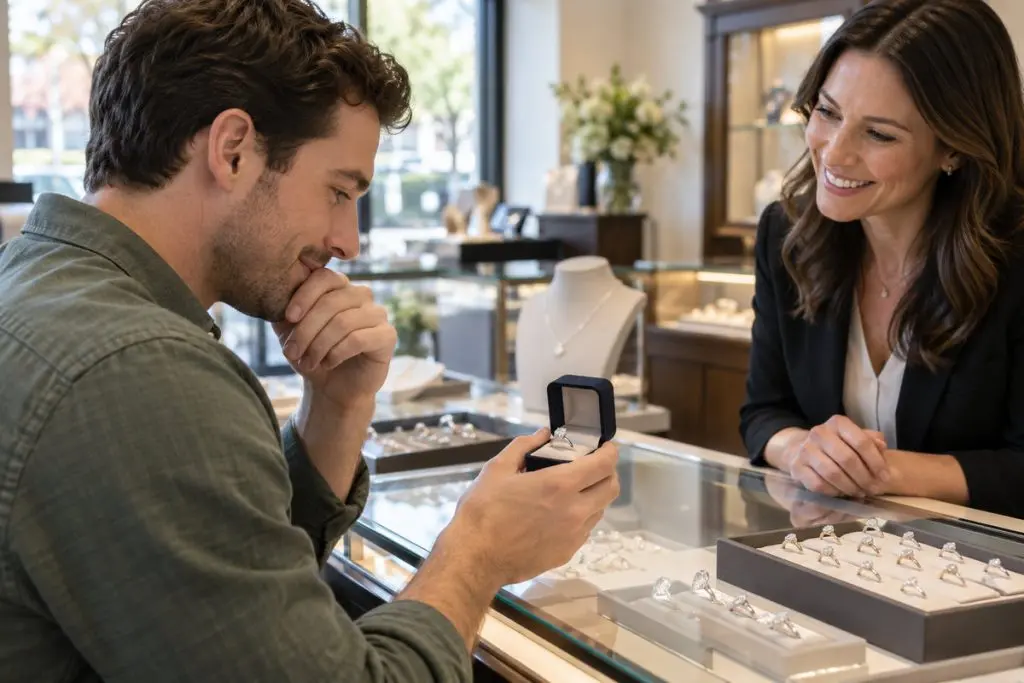
You’re out ring shopping and find the perfect fit. Unfortunately, it’s a bit more than you’d like to pay upfront. The jeweler suggests monthly payments. If you choose to finance your ring, you’ll be in good company: one in three people who bought a new engagement ring borrowed to help pay for it, according to The Knot’s 2024 Jewelry and Engagement Study.
But how does engagement ring financing work, and which option makes the most sense for your budget? Here’s what you need to know before making your decision.
KEY TAKEAWAYS
- Financing may let you buy a ring without paying the full price upfront.
- A smaller monthly bill could mean spending more.
- Check the end date on special financing deals.
- Your credit history can affect the terms you get.
- A lower-priced ring may be worth considering if the financing payments are too high.
How Does Engagement Ring Financing Work?
Financing allows you to purchase an engagement ring now and spread the cost over time, rather than paying the full price upfront. Depending on the financing option, you’ll make payments to a lender, credit card provider, or financing company working with the jeweler.
When the jeweler shows you a monthly payment, ask how many months you’ll be paying it. If there’s a special financing offer, find out when it ends, too. You don’t want to agree to a plan only to discover later that the ring will cost more than you expected.
APR, Fees, and Total Repayment
Say you’ve found a ring for $2,000. If you need to borrow money to buy it, you could end up paying more once interest and fees are added. Even if the monthly payments seem affordable, you’ll want to know what the ring will cost you by the time you pay it off.
To understand the full cost, start by checking the annual percentage rate (APR). For personal loans, this includes the interest rate and certain lender fees.
You’ll also want to compare the monthly payment, repayment period, and total amount owed. For example, financing a $2,000 engagement ring over three years might give you smaller monthly payments than a two-year loan, but you could end up paying more in interest.
Promotional Financing
When shopping for an engagement ring, you might come across a jeweler offering 0% APR financing for a limited time. For example, a store might let you spread the cost of a ring over 12 months without paying interest. These promotions can make financing more affordable, but not all offers work the same way.
A true 0% APR offer means you won’t pay interest on the ring during the promotional period. But if you haven’t paid it off when the offer ends, interest may start building on what you still owe.
Watch out for deferred interest offers, though. A jeweler might advertise “no interest if paid in full within 12 months.” Leave even a small balance after that deadline, and you could owe interest going all the way back to the purchase date. This can happen even if you’ve made every minimum payment on time.
Say you finance a $2,400 ring with a 12-month deferred interest offer. You’d need to pay $200 a month to clear the balance in time, assuming there are no fees. The minimum payment could be much lower, so work out what you actually need to pay each month before signing up.
Engagement Ring Financing Options
If the jeweler offers financing at checkout, you might be tempted to accept it and get the purchase sorted. Before you do, it’s worth seeing how that offer compares with a personal loan, credit card, or buy now, pay later plan. The monthly payments and overall costs can be quite different.
| Payment Method | Repayment Structure | Potential Costs | Main Benefit and Consideration |
|---|---|---|---|
| Jeweler financing | Payments under a retailer-arranged credit agreement | Interest, fees, possible deferred interest | Convenient at checkout, with possible promotional rates; check the terms |
| Personal loan | Set payments over an agreed term | Interest, possible origination and late fees | Fixed monthly payments can make budgeting easier; interest and fees may increase the total cost |
| Credit card | Payments toward a revolving balance | Purchase APR, possible fees | Flexible payments and possible 0% introductory APR offers; carrying a balance can be expensive |
| Buy now, pay later | Short or longer installment plans | Possible interest and late fees | Spreads the cost into smaller installments; check payment dates and potential charges |
Jeweler Financing
If you’ve found a ring at a jewelry store, ask what financing they offer before applying for a loan elsewhere. Some jewelers work with lenders that offer store credit cards or installment loans, sometimes with promotional interest rates. You might find an offer that works better for your budget than a separate personal loan.

A jeweler’s 12-month promotional offer might save you money compared with a personal loan. But check whether it offers a true 0% APR or charges deferred interest if you miss the payoff deadline. You’ll also want to know if there’s a down payment, what fees you’ll pay, and how much you’ll owe by the end of the repayment period.
Personal Loans
If the jeweler’s financing offer doesn’t suit you, a personal loan could be another option. You can apply through a bank, credit union, or online lender and use the money to pay for the ring. You’ll then repay the lender in monthly installments, often at a fixed interest rate. That makes it easier to know what you’ll owe each month and when the payments will end.
One advantage of a personal loan is that you can compare offers from several lenders before choosing one. Look at the APR, monthly payments, repayment period, and total borrowing cost. Some lenders also charge origination fees, which may be deducted from the loan amount before you receive the money. Check that the amount you’ll actually receive covers what you need for the ring, and ask whether there are charges for paying off the loan early.
Credit Cards
If you already have a credit card with enough available credit, you may be able to use it to buy the ring, as long as the jeweler accepts it. Carrying a balance could add interest to the ring’s price. Another possibility is applying for a card with 0% introductory APR on purchases, which could give you time to pay for the ring without interest.
For a 0% offer, divide the amount you’ll charge by the months left in the promotion to see whether you can afford to pay it off in time. The minimum payment may be lower. Just make sure the introductory rate applies to purchases and not only balance transfers. If you still have a balance when the promotion ends, the card’s regular purchase APR may apply to what you still owe.
Buy Now, Pay Later
You might see a buy now, pay later (BNPL) option when checking out at an online jewelry store. If your purchase qualifies, you could split the cost into four smaller payments or choose a longer monthly payment plan. What you’ll be offered depends on the provider, the ring’s price, and your eligibility.
Say you find a $2,000 ring and the store lets you split the price into four interest-free payments. That’s $500 every two weeks, with the first payment due at checkout. That means paying off the ring in six weeks. For a pricier ring, you might be offered monthly installments instead, though interest may apply.
Before agreeing, see how much you’ll need to pay that day and when the remaining payments are due. Check for interest and fees, and find out whether the provider will run a credit check or report your payments to credit bureaus.
How Much Should You Finance for an Engagement Ring?
If you’re planning to borrow money for a ring, start with what you could comfortably repay each month. The old advice about spending several months’ salary on an engagement ring won’t tell you what’s affordable after rent, bills, and other expenses. As personal finance expert Snigdha Kumar told The Knot, “Budgeting for an engagement ring should be tailored to your own financial situation.”

Start with your take-home pay, then subtract what you spend on rent, groceries, transport, and existing debts. Planning a wedding or moving soon? Leave room for those expenses, savings, and unexpected costs, too. What’s left should help you work out how much you can comfortably pay toward the ring each month.
Let’s say the ring costs $2,500 and you can put $500 down. That leaves $2,000 to finance. Here’s how the numbers could work out with an example loan:
- Ring price: $2,500
- Down payment: $500
- Amount borrowed: $2,500 − $500 = $2,000
- Example loan terms: Fixed 15% APR over 24 months, with no fees
- Monthly payment: About $96.97
- Total loan payments: Around $2,327.36
- Interest paid: $2,327.36 − $2,000 = $327.36
- Total ring cost with down payment: $2,827.36
These figures are estimates, so rounding may cause small differences. The 15% APR is hypothetical, not a rate being offered by a lender.
If you’re also looking into wedding loans for the ceremony or reception, think about how those payments would fit alongside what you’ll owe for the ring.
Want to see how a different loan amount or term changes the cost? Try the wedding loan calculator. It provides estimates, not loan quotes or approvals.
How to Compare Financing Costs Before Committing
When you’re trying to keep the monthly payments low, a longer repayment plan can seem appealing. But before choosing one, take a closer look at:
- Cash price: What the ring costs if you pay upfront.
- Amount financed: How much you need to borrow after any down payment.
- APR and fees: The interest and other charges, without counting fees twice.
- Payment terms: Your monthly payment and when the loan ends.
- Other conditions: Special offer deadlines, late fees, or charges for paying early.
Take the $2,000 loan we discussed earlier. At 15% APR with no fees, you’d pay about $96.97 monthly for 24 months. Stretch that to 36 months, and it’s around $69.33. Sounds better, until you compare the totals: $2,327.36 versus $2,495.90. That’s $168.54 extra.
How to Finance an Engagement Ring with Bad Credit
If your credit score isn’t where you’d like it to be, you may still have options for financing an engagement ring. Approval isn’t guaranteed, though, and you could face higher interest rates. Lenders may also look at your income, existing debts, and payment history when deciding whether to approve your application.
If the monthly payments are more than you can manage, try asking your bank or credit union what they could offer. A less expensive ring might also be worth considering. Before applying, take a look at your credit reports for mistakes. Fixing an error may help you get better terms, depending on the rest of your credit history.
Some lenders let you apply with a co-signer, but that person would also be responsible for the full unpaid debt. Missed payments can affect their credit, too.
Ask whether the application involves a soft or hard credit inquiry. A soft inquiry won’t affect your credit score, while a hard one might. An initial soft check may be followed by a hard inquiry when you formally apply.
What If Financing Payments Are Still Too High?
If even the lowest monthly payment seems hard to manage, you still have a few options. Choosing a smaller center stone, a lab-grown diamond, or a simpler setting could bring the ring’s price closer to your budget. You might also have a family ring that only needs cleaning or resizing.
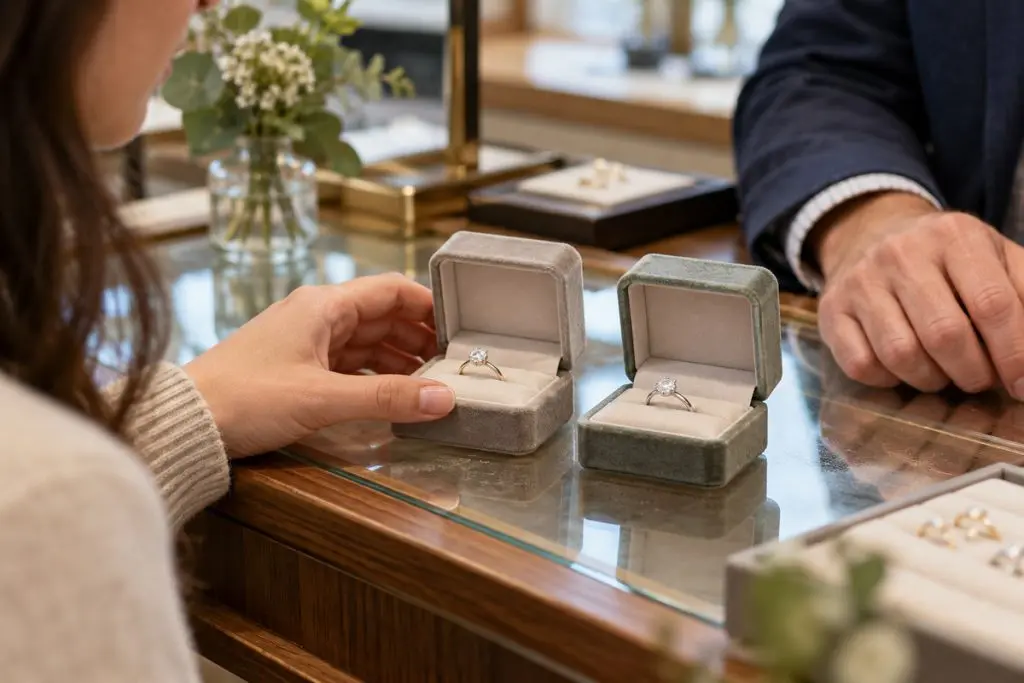
If you’re not in a rush, saving toward a down payment could help you borrow less. You don’t necessarily have to save the full purchase price, and putting some money aside first may give you more flexibility when you’re ready to buy.
Common Mistakes to Avoid
It’s easy to get caught up in buying the ring and miss something in the financing terms. Here are a few things to watch for:
- Borrowing up to your limit: Just because you’re approved for a certain amount doesn’t mean you can afford the payments.
- Picking the lowest payment: A longer loan could mean paying more interest.
- Overlooking promotional terms: Check when the offer ends and what fees apply.
- Applying to several lenders: Some applications involve hard credit checks that can affect your score.
Final Thoughts on Engagement Ring Financing
Finding the ring you want can make it tempting to sort out the payment there and then. But you don’t have to accept the first financing offer you get. Ask how long you’ll be paying for the ring and what it’ll cost altogether. Then see how those payments fit with your usual bills.
If the numbers are too tight, try another lender or consider a less expensive ring. You can take a little more time to decide, even if you’ve already found the perfect ring.
FAQ
Can You Finance an Engagement Ring or Wedding Band?
If a financial institution approves you, you can use a personal loan, a credit card, store financing, or certain installment plans to pay for an engagement ring or wedding band. Approval and permitted purchases depend on the provider. Ask the jeweler which payment methods it accepts before choosing a plan, especially if you’re ordering a custom ring.
What Credit Score Do You Need to Finance an Engagement Ring?
The credit score you’ll need depends on the lender, since each provider sets its own approval requirements. Your income, debt, and repayment history may matter alongside your score. Even if you qualify, check the rate and fees. A loan that’s offered to you isn’t automatically a good fit for your budget.
Is Jeweler Financing Cheaper Than a Personal Loan?
It can be, but compare the full repayment amounts. A jeweler’s genuine 0% APR promotion could cost less if you clear the balance in time. A deferred interest offer may become expensive if you miss the deadline. Personal loans can also carry origination fees, so compare like-for-like amounts.
Can You Finance an Engagement Ring With Bad Credit?
You may still qualify for financing, even with bad credit. Keep in mind that approval isn’t certain, and the interest could be high. Choosing a cheaper ring or putting more money down means borrowing less. If the payments seem too steep, you can always hold off and save a little longer.
Does Financing an Engagement Ring Build Credit?
It might, if the provider reports your account and payments to credit bureaus. Making payments on time can help your payment history, while missed payments may hurt it. Some plans don’t report positive payments at all. Taking on a loan doesn’t guarantee that your credit score will rise.
Can You Pay Off Engagement Ring Financing Early?
It depends on your provider, but most plans let you pay off your ring before the final due date. Before making that last payment, see if your lender charges a fee for paying early. If you have a promotional rate, check when it expires. Paying ahead of schedule could save you interest, though that isn’t always the case.