
A money order may be easier to get for smaller payments, especially if you don’t have a bank account. A cashier’s check can be a better choice for larger amounts or when someone asks for a single bank-issued check. You’ll need to pay the full amount upfront for either one.
But money orders aren’t always cheaper. If your bank offers cashier’s checks for free, you could end up paying less than you would for several money orders. That’s why it’s worth checking the fees before deciding.
To choose between them, you’ll need to look at what the recipient accepts, where you can buy each one, and what you’ll pay. We’ll compare the costs and show you how to use the payment planner to work out your total.
Money Order vs. Cashier’s Check at a Glance
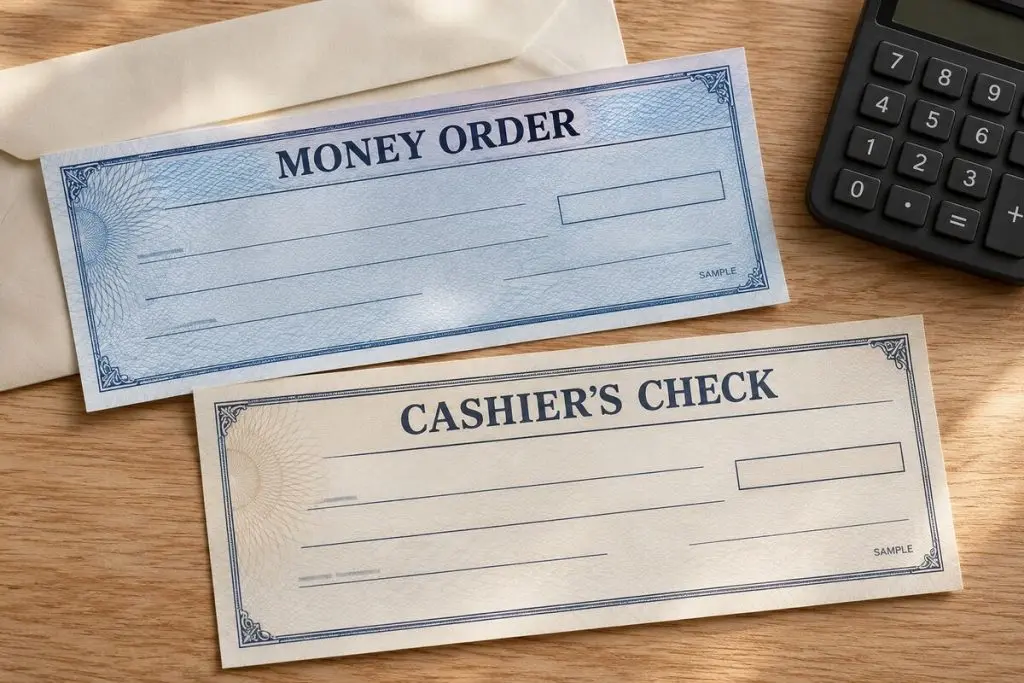
A money order is a prepaid paper payment made out to a specific person or business. You can buy one at a post office, certain stores, or some banks. Just pay the amount you want to send, plus the purchase fee, and write in the recipient’s name. You can then give it to them or send it by mail. Money orders are often used for bills and everyday purchases.
A cashier’s check is a check a bank or credit union issues from its own funds. You pay the institution upfront, and it makes the check payable to your recipient. People often use cashier’s checks for larger transactions, such as buying a car, or when a seller specifically asks for one.
Some recipients prefer money orders or cashier’s checks because they don’t want to handle large amounts of cash. These payments are also made out to a named recipient, and the purchaser can keep a record of the transaction.
| Feature | Money Order | Cashier’s Check |
|---|---|---|
| Issuer and purchase location | USPS, retailers, and some banks or credit unions | Banks and credit unions |
| Amount limits | Set by issuer; USPS allows up to $1,000 per domestic order | Bank-specific; not automatically unlimited |
| Bank account required | Generally not at post offices or retail stores | Usually required; ask about noncustomer policies |
| Purchase funds | Typically cash or debit at major retail and postal issuers | Available funds through an approved bank payment method |
| Fees | Often per order, sometimes based on amount | Usually per check; some accounts have waivers |
| Recipient acceptance | Confirm whether the recipient permits one or several | Confirm the recipient accepts a cashier’s check |
| Lost or stolen | Issuer inquiry and possible replacement or refund | Bank claim, possible waiting period or bond |
Neither instrument is fraud-proof. A genuine payment can be useful, but a counterfeit money order or cashier’s check can look convincing.
Check What Your Recipient Accepts First
Before buying a money order or cashier’s check, find out how the recipient wants to be paid. Some landlords accept multiple money orders for rent, while a car seller might ask for one cashier’s check. Knowing this beforehand can save you from buying a payment they won’t accept.
Confirm the following details:
- Payment type: Money order, cashier’s check, or either?
- Payee: What exact name should appear on the payment?
- Amount: Is there one exact balance, or are separate payments required?
- Multiple money orders: Can you combine money orders if one won’t cover the total?
- Deadline and delivery: Must the recipient have the document by a certain date, and can you hand-deliver or mail it?
If the instructions say “certified funds,” ask what that means to the recipient. A certified check is a distinct bank product, and the phrase shouldn’t be treated as permission to use any prepaid payment method.
Receiving a cashier’s check doesn’t always mean the money is ready to spend. The recipient’s bank may need more time to make the deposited funds available.
For example, someone could receive a cashier’s check on Friday but still have to wait before using the money. If timing is a concern, they can ask their bank when the deposit will be available.
If the recipient allows an electronic or cash-pickup alternative, Walmart-to-Walmart money transfers may be worth discussing. A transfer isn’t a money order, so get permission before switching methods.
Compare the Cost of Your Payment
Choose USPS money order, cashier’s check, or compare both, then enter your payment amount and answer the questions that appear. The planner estimates purchase totals, shows how many money orders you need, and flags details to confirm before buying. For a cashier’s check, enter your bank’s confirmed fee, including $0 if waived. If the fee is unknown, the cashier’s-check total stays unknown.
Payment Planner
The payment planner needs JavaScript to calculate costs.
Choose a payment option your recipient accepts. Compare both if either works.
Before you go, confirm the exact payee name and payment deadline.
For planning only. Estimates cover the payment amount and issuing fees. Travel, mailing, and cashing costs are separate. Confirm the final total and buy directly from the issuer.
- Issuing Fees
- Estimated Total
For example, say you need to pay $1,200. The recipient accepts either one cashier’s check or two money orders. Your bank has confirmed it can issue the check for a $10 fee.
| Option | Purchase Plan | Purchase Fees | Purchase Total |
|---|---|---|---|
| USPS money orders | $1,000 + $200 | $6.40 | $1,206.40 |
| Cashier’s check | One $1,200 check | $10 illustrative bank quote | $1,210 |
Under USPS’s published fee schedule, the $1,000 order costs $3.75 to issue and the $200 order costs $2.65. The fees were verified on November 11, 2026.
In this case, the money orders would save you $3.60. But if your bank waives the cashier’s-check fee, the check would cost less. And if the recipient only accepts one payment document, two money orders wouldn’t be an option.
The planner includes the payment amount and issuing fees. You’ll need to account for any mailing, travel, or cashing costs separately.
How Much Do Money Orders and Cashier’s Checks Cost?
The purchase fee depends on the issuer, how much you’re paying, and any bank-account benefits. Rather than relying on a national average, compare actual published fees. A “maximum” fee also isn’t the same thing as a price confirmed for your particular location.
Published U.S. fees, checked November 11, 2026:
| Provider and Instrument | Published Purchase Fee | Amount Limit and Fee Conditions | Official Source |
|---|---|---|---|
| USPS domestic money order | $2.65 for $0.01–$500; $3.75 for $500.01–$1,000 | $1,000 per order | USPS |
| Walmart money order | Up to $1 | Exact fee and limit must be confirmed with the store | Walmart |
| Chase money order | $5 | Up to $1,000 per order; no issuing fee for Chase Secure Checking customers | Chase |
| Chase cashier’s check | $10 | No issuing fee for Chase Secure Checking customers; confirm availability and amount requirements | Chase |
| Bank of America cashier’s check | $15 | Fee waived for BofA Rewards members at the Preferred Plus tier or higher; confirm amount requirements | Standard fee Rewards waiver |
| Wells Fargo cashier’s check | $10; waived for Prime Checking and Premier Checking customers | Online orders up to $2,000; visit a branch for larger amounts and applicable limits | Fee schedule Online orders |
Chase Secure Checking customers don’t pay issuing fees for money orders or cashier’s checks. Bank of America also waives its $15 cashier’s-check fee for BofA Rewards members at the Preferred Plus tier or higher. Wells Fargo offers the same benefit to Prime Checking and Premier Checking customers.
Keep in mind that these benefits don’t necessarily remove your account’s monthly service fee.
How Purchase Methods and Multiple Orders Affect the Total
USPS and Walmart accept cash or debit cards for money orders, not credit cards. Bank-issued cashier’s checks generally require available funds and an approved funding method. Wells Fargo lists an $8 delivery charge for online cashier’s-check orders sent to a U.S. address, in addition to any applicable issuing fee.
USPS allows up to $1,000 per domestic money order. For large payments, you’ll need more than one order and will pay a fee for each.
Say you’re paying $1,500. You could buy one money order for $1,000 and another for $500. This brings the purchase fees to $6.40. This works if the recipient accepts two money orders. If they require one payment document, you’ll need another option, such as a cashier’s check.
Before buying, confirm the issuer’s current charge and whether its branch or store can process your amount. Don’t estimate an unknown Walmart fee or bank quote as though it were confirmed.
Which Option Fits Your Situation?
The better choice depends on your circumstances. Think about how the recipient wants to be paid, where you can buy each option, and how much you’ll have to pay in fees.
| Situation | Deciding Factor | Suitable Option | Still Confirm |
|---|---|---|---|
| Smaller payment; your bank confirms a free cashier’s check | No issuing fee | Cashier’s check | Recipient acceptance and issuance |
| Paying $1,200, and the recipient accepts two money orders | Cost of buying two orders | Two money orders, if their total fee is lower | Seller’s fees and the amount of each order |
| Paying $1,200, but the recipient wants one payment document | Recipient accepts only one payment | Cashier’s check, if accepted | Bank fee and availability |
| No access to a bank that will issue you a cashier’s check | Purchase access | Money order, if accepted | Payee approval and issuer requirements |
How to Buy a Money Order or Cashier’s Check
Where you buy your payment can make a difference in which option you choose. Money orders are available at post offices and participating stores, often without a bank account. Cashier’s checks usually require you to go through a bank or credit union. You’ll also need to consider how you can pay and how soon you need the document.
Buying a Money Order
A money order may be convenient if you want to pay with cash or a debit card. For example, USPS sells domestic money orders for up to $1,000 each, so larger payments may require more than one.
Here’s how to buy one:
- Find a seller. Check the location’s hours, fees, and purchase limits.
- Bring what you need. Have the recipient’s name, payment amount, and enough cash or debit funds to cover the purchase. Ask if identification is required.
- Fill out the money order. Follow the seller’s instructions for adding the payee’s name, your information, and any required signature.
- Keep your receipt. You’ll need the purchase details if you ever have to track or replace the money order.
Getting a Cashier’s Check
A cashier’s check can be useful if you need to make a larger payment without buying several money orders. However, you’ll need to find a bank or credit union that can issue one for you.
Here’s how to get one:
- Contact the bank. Ask whether you need an account, what the fee is, and whether you can get the check that day.
- Prepare the funds. Find out how the bank accepts payment and make sure you have enough money to cover the check and any fee.
- Provide the payment details. Bring your ID and give the bank the recipient’s exact name and the amount. Check that both are printed correctly before leaving.
Some banks allow online orders, but delivery can take longer and may cost extra. If you’re in a hurry, a branch visit may be more practical.
If You Do Not Have a Bank Account
You can usually buy a USPS or Walmart money order without opening a bank account. That makes it a useful option if you’re paying with cash or a debit card.
A cashier’s check may be harder to obtain. Some banks issue them only to customers, so call ahead to ask about their policy.
If the recipient requires a cashier’s check and you can’t get one, explain the situation and ask whether they’ll accept another payment method.
What to Check When You Are Receiving Payment
If someone pays you with a money order or a cashier’s check, take a moment to review it. You want to make sure the details are correct and that you can cash or deposit it without problems.
Here’s what to look for:
- Your name: Is it written correctly? A mistake could prevent you from cashing or depositing the payment.
- Payment amount: Does the amount match what you’re owed? Check both the numbers and the written amount.
- Issuer: Which bank, credit union, or money-order provider issued the payment? If you need to verify it, contact the issuer using its official website.
- Changes or mistakes: Look for crossed-out names, altered amounts, or other corrections that could cause problems.
- Deposit options: Will your bank accept the payment? Ask about any fees, identification requirements, and when the funds will be available.
If you want to deposit the payment with your phone, check whether your banking app or a check-cashing app accepts that type of document. Some services have restrictions.
If something looks wrong, speak with the sender before trying to cash or deposit it.
What If It Is Lost, Stolen, Incorrect, or No Longer Needed?
Contact the issuer promptly. Have the receipt or purchase stub, amount, date, serial number, and payee name ready if available. Don’t assume that either instrument can be canceled or refunded immediately.
Lost or stolen USPS money order: USPS says you cannot stop payment on a postal money order, but you can request an inquiry at a post office using your receipts. Its replacement rules list a $23 processing fee. Confirming a loss or theft may take up to 30 days, and investigating its status may take up to 60 days. Replacement depends on the inquiry.
Lost or stolen retail money order: Follow that issuer’s process, which may differ from USPS. Walmart sells Western Union money orders. Under Western Union’s terms, eligible refunds for money orders worth $100 or more carry a $15 processing fee. Refund eligibility depends on whether the order has been presented or cashed and on the documentation supplied.
Lost or stolen cashier’s check: Call the issuing bank. It may require a written claim, an indemnity agreement, or a surety bond, which provides a financial guarantee against certain losses. Wells Fargo states that reissuing outstanding checks over $1,000 generally involves a 90-day waiting period, with 30 days in Wisconsin and 91 days in New York; an acceptable surety bond may avoid the wait.
If there’s a mistake or you no longer need the payment: Don’t try to fix a wrong name or amount by crossing it out. Instead, contact the issuer to find out if you can correct, replace, cancel, or get a refund for the payment. Your options may depend on whether you still have the document and whether someone has already cashed it.
Choosing Between a Money Order and Cashier’s Check
A money order may be more convenient if you don’t have a bank account or want to pay at a nearby store. For larger amounts, a cashier’s check could save you from buying several money orders. But before you choose, find out what the recipient accepts and how much each option will cost you. Don’t forget to check the name and amount when you make the purchase. You can also use the payment planner to compare fees and see what you’ll need to bring.
FAQ
Is a Certified Check the Same as a Cashier’s Check?
No, they’re two different types of checks. With a certified check, you write a personal check, and your bank confirms your signature and sets aside the money to cover it. With a cashier’s check, the bank issues the check itself and takes responsibility for paying it. Since they work differently, it’s worth asking the recipient which one they’ll accept.
Can You Buy a Money Order With a Credit Card?
You can’t buy money orders with a credit card at USPS or Walmart. Both accept cash and debit cards. Other sellers may have different rules, but check with your card provider first. Some card agreements treat money-order purchases as cash advances, which can mean extra fees and interest. The Consumer Financial Protection Bureau explains how these transactions may be classified.
Can You Use Multiple Money Orders for One Payment?
Yes, but only if the person or business you’re paying allows it. Say you owe $1,500. You could buy two USPS money orders, one for $1,000 and another for $500. Keep in mind that you’ll have a separate fee for each one. It’s also worth checking whether the recipient wants the full amount on a single payment document.
Do Money Orders or Cashier’s Checks Expire?
USPS domestic money orders never expire. The same goes for Western Union money orders, although inactivity fees may reduce their value after one to three years, depending on state law. Cashier’s checks work differently, as bank policies and state unclaimed-property laws may affect older checks. If you’ve had one sitting around for a while, ask the issuer what you can do with it.